
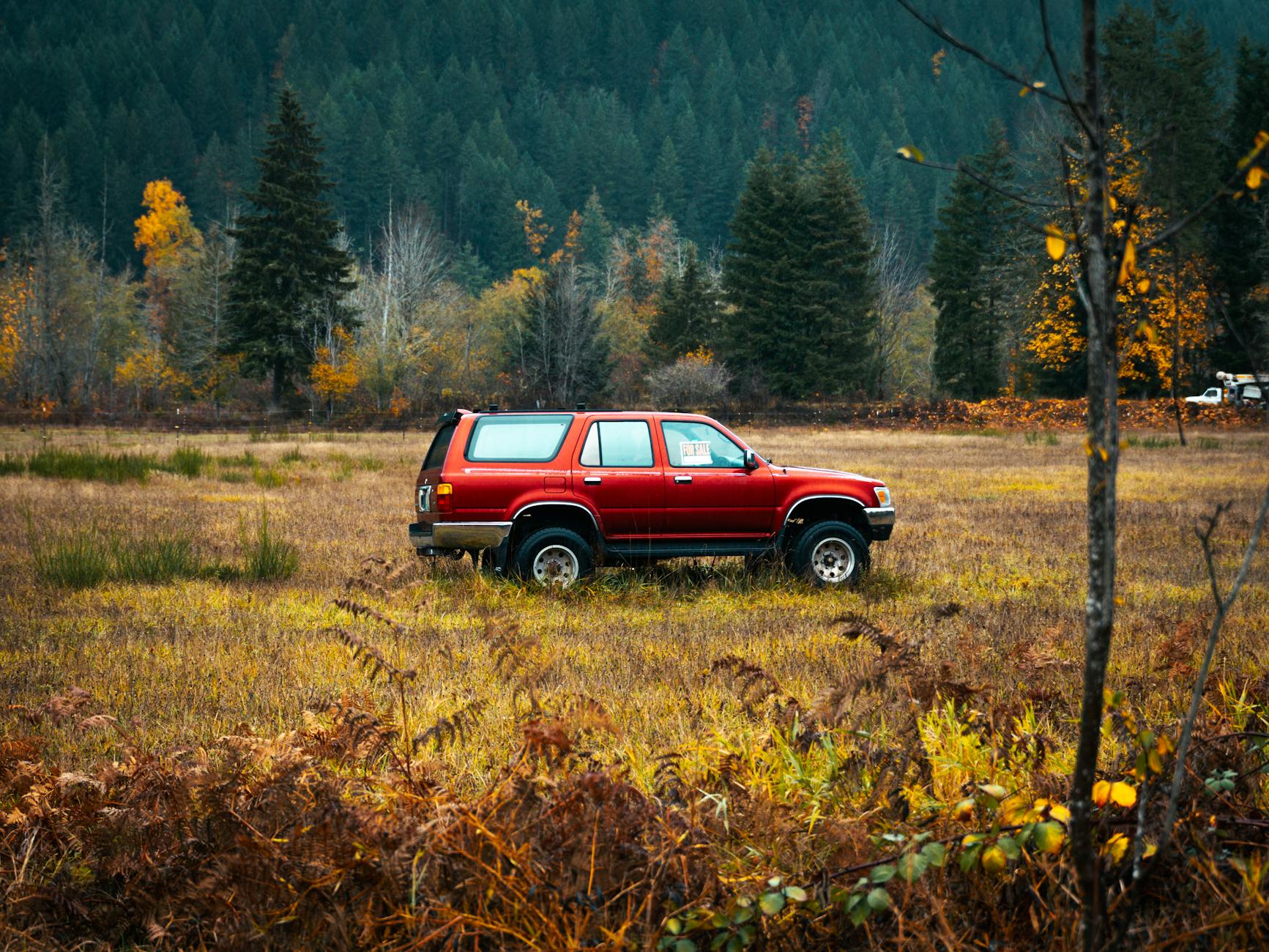


This one has a history of production since 1984 and a lifespan of six generations. Launching as a short pickup truck with bolt on fiberglass top, the 4Runner has grown into one of the most capable and longest running body on frame SUVs on the market. Each generation introduced new engines and new technology, and a devoted audience that endures even decades later.
1st Generation 4Runner (1984 to 1989): Where it Started

The 1st of the Toyota 4Runner generations was not really an SUV. Instead, it was more like a Toyota Hilux with rear seats bolted in and a removable fiberglass bed. That simplicity, the simplicity, is what was special about the thing. The 1984 and 1985 models are the only 4Runners that have a true solid front axle under their bonnets, and make them extremely popular with serious off road builders today.
The engine powering the 1st gen was a 2.4L 22R inline four, which generated 105 hp. In 1985 fuel injection drove that up to 116 hp. A 3.0L V6 arrived in 1988, but the four cylinder engine is still the one most enthusiasts chase. And all for the 1st gen, there was a two speed transfer case and manually locked hubs. The removable top is the new hallmark for this generation, and also the first time Toyota made a convertible 4Runner.
What to know before buying: Clean 1st gen 4Runners are becoming more and more rare and rust takes the front seat. Solid front axle models (1984 to 1985) command a premium. Expect to spend $3,000 to $15,000 on a running example, with pristine solid axle trucks charging well above that. At this point, the 1st gens are collector trucks, not everyday drivers.
2nd Generation 4Runner (1990 to 1995): The Real SUV Arrives

The second gen ushered in the time when the 4Runner was indeed a legitimate SUV. Missing this removable fiberglass top, the rear body had a permanent steel body, a coil sprung suspension on almost every side. The engine options all carried over from the 1st gen, the 2.4L four cylinder and the 3.0L 3VZ-E V6. The V6 is where most buyers ought to pay special attention. The 3.0L engine is notorious for head gasket failure, an expensive repair that Toyota didn’t seem to quite fix over this generation. This single piece of the puzzle is what accounts for the 2nd gen not possessing the same reliability reputation as the 3rd gen since.
What to know before you buy: If you choose a second gen with the four-cylinder, you’ll enjoy greater reliability in the drivetrain, but you may find the power output lacking. V6 cars need a thorough inspection of their head gaskets. Currently, prices range from $3,000 to $15,000, depending on the vehicle’s condition. At this stage, collectors primarily seek these trucks. The 1991 model year stands out as the most reliable of the 2nd gens.
3rd Generation 4Runner (1996 to 2002): The One Enthusiasts Call the Best

Ask any 4Runner forum which generation makes the most dollars, and you’ll find that three generations consistently top the list. The 3.4L 5VZ-FE V6, producing 183 horsepower, stands out as one of the Toyota 4Runner generations most reliable engines. The 3rd gen benefits from this engine, which it shares with the first gen Tacoma, and finding models with 300,000 miles is quite common.
The 3rd gens were built from the ground up on a new platform. Notably, it shared architecture with the Land Cruiser Prado J90 and featured coil springs on all four corners for the first time. Ultimately, this innovative design created a truck that could easily tackle off-roading while, at the same time, maintaining comfort on the highway. Additionally, they included a factory rear locking diff, which continues to attract many off-road buyers today.
A base 2.7L four cylinder was affordable for buyers wanting maximum fuel economy, but the engines you’ll want to buy at the end of the road are most likely the 3.4L V6. V6 tow range maxes out at 5,000 lbs (adequate for small boats and utility trailers).
What to know before buying: The 3rd gen is the sweet spot for owning a 4Runner. Notably, it remains reasonably priced ($8,000 to $25,000+), and you can easily find parts. Additionally, you’ll notice a significant improvement in the driving experience compared to the previous generation. However, clean, low mileage examples are becoming increasingly rare, often exceeding $20,000 in collector markets. Watch out for rust, especially frame rust on trucks from the Midwest and Northeast, as well as worn suspension components. Also, keep in mind the timing belt service interval of 90,000 miles. Finally, make sure that the service records show that the aforementioned maintenance was completed; if not, budget for a timing belt and water pump replacement.
4th Generation 4Runner (2003 to 2009): The Only V8 and The Most Polarizing Design

However the 4th gen is the 4Runner that has most controversy ever built. Toyota relocated the design in a softer, more suburban direction with rounded styling and a luxury oriented interior. The look was universally hated by traditional 4Runner buyers. Underneath, though, this generation had an extra offering from the likes of which no other 4Runner has offered before or since: a V8 engine.
The standard engine was a new 4.0L 1GR-FE V6 capable of 245 horsepower. The extra feature 4.7L 2UZ-FE V8 pushed 270 horsepower into an extended, 7,300 lb tow capacity. That V8 in the 4th gen is the same engine inside the Toyota Tundra and Land Cruiser of the time. It is in many ways bulletproof with routine maintenance and V8 4th gen 4Runners represent the holy grail of the used market. Owners rarely sell them.
The 2003 problem: The first model year of any generation typically faces more issues, and the 2003 4Runner stands out as the most complained about 4Runner in the NHTSA records. Early production models suffered from quality control issues, frame rust, and reports of worn out interior components that needed replacement sooner than expected. The facelift in 2006 introduced a new front end, LED taillights, and resolved nearly all early production problems. For those considering this generation, the 2006 and 2009 models are safer options.
What to know before buying:
The 4th gen is currently the most undervalued 4Runner generation. Buyers can find used pricing ranging from $5,000 to $15,000+, making V8 truck-based SUVs with Toyota reliability accessible for those who cannot afford a 5th gen. Be cautious with early models (2003 to 2005) as they are prone to severe rust; however, buyers prefer 2006 to 2009 models for their updated V6/V8 powertrains and improved safety features. Even fourth gen models with over 170,000 miles still average over $11,000, demonstrating strong long-term value retention. The 2006 to 2009 range offers the best value for budget-conscious buyers.
5th Gen Toyota 4Runner (2010 to 2024): Overlanding Icon

The 5th gen 4Runner boasts an impressive production run of 14 model years, from 2010 to 2024. This duration marks the longest production cycle in the history of all Toyota 4Runner Generations, fostering a robust used market ecosystem within the truck-based SUV segment. If you decide to buy a 4Runner today, you are likely to choose a 5th gen model.
The production took a return to a tough boxy look that intentionally called back the truck origins of the original 4Runner. All production runs were driven by a 4.0L 1GR-FE V6 with 270 horsepower paired to a 5 speed automatic transmission. That combination of powertrains is willfully conservative. The 5 speed auto is old tech, but it is virtually indestructible, and the V6 regularly goes up to 300,000 miles with simple maintenance.
Toyota introduced the TRD Pro trim in 2015, the halo model of the 4Runner lineup. Featuring Fox internal bypass shocks, factory lift, and season by season color options such as Voodoo Blue and Lunar Rock, the TRD Pro made the 4Runner the de facto overlanding best. It is nothing short of monstrous aftermarket support for the 5th gen. There are lift kits, bumpers, roof racks, lighting and armor from dozens of manufacturers.
The 2014 facelift beefed up the front end styling and introduced a tougher grille, adding aggression to the front end styling. Apple CarPlay and Android Auto came in the 2020 model year. Otherwise, the fundamental truck stayed constant for the most part.
What to know ahead of purchase:
This generation dominates the market, with used prices ranging from $11,000 to over $50,000. Here’s the breakdown by era: 2020 to 2024 models go for $30,000 to over $45,000 due to high demand and standard Safety Sense P. 2014 to 2019 models sell for $20,000 to $35,000. 2010 to 2013 models are available from $11,000 to $20,000, but they have lower availability and lack modern safety features. The 2017 model year stands out as the most desirable pre-owned 4Runner, benefiting from the 2014 facelift, boasting a solid reliability record, and finally experiencing a slight drop in prices. On the TRD Off Road and TRD Pro trims, the ground clearance measures 9.6 inches.
6th Generation Toyota 4Runner (2025 to Present): The Turbo Era Begins

The latest of the Toyota 4Runner generations boasts the biggest change in the nameplate’s history. Its classic 4.0L V6 is obsolete, replaced today by a 2.4L turbocharged four cylinder (i-FORCE) churning 278 horsepower and 317 lb ft of torque. This new hybrid version (i-FORCE MAX) also bumps output to 326 horsepower and 465 lb ft of torque. The old 5 speed automatic is swapped out for an 8 speed unit.
The platform is new too. The 6th gen sits atop Toyota’s TNGA-F global truck architecture, as does the present Tacoma, Tundra, Land Cruiser as well as Sequoia. Older design has been replaced with multi link coil rear suspension and double wishbone front setup. On its base model ground clearance is 8.1 inches and increases to 10.1 inches of ground clearance on Trailhunter, which is a new factory overland trim developed to function for expedition uses.
The trim lineup is the widest ever produced on the 4Runner: SR5, TRD Sport, TRD Off Road, Limited, Platinum (the 4Runner’s first), TRD Pro, and Trailhunter. Starting MSRP is around $42,000 with fully loaded Trailhunter and TRD Pro models pushing $69,000 to $72,000.
Elephant in the room: The leap from naturally aspirated V6 to turbocharged four cylinder is the most polarizing subject in the 4Runner community for now. Its enthusiasts are concerned about the long term reliability of the turbo, its loss of V6 style sound and the complexity of a turbo system it brings along with the car. Toyota’s argument against it is more power, more torque, improved fuel economy, and a proven turbo design that can be applied over the full width of the entire truck lineup to its trucks. Whether the 2.4L turbo will receive the same legendary status as the engines before it will come down the pike in time.
Toyota 4Runner Generations Comparison: Specs, Pricing, and Engines at a Glance
The table below puts all Toyota 4Runner generations side by side allowing you to compare the numbers that will have an impact the most.
| Gen | Years | Engine | HP | Tow (lbs) | US Sales (est.) | Used Price | MSRP | Best For |
| 1st | 1984 to 1989 | 2.4L I4 / 3.0L V6 | 105 to 150 | 3,500 | ~150,000 | $3K to $15K+ | N/A | Collectors |
| 2nd | 1990 to 1995 | 2.4L I4 / 3.0L V6 | 105 to 150 | 3,500 | ~350,000 | $3K to $15K+ | N/A | Budget builds |
| 3rd | 1996 to 2002 | 2.7L I4 / 3.4L V6 | 150 to 183 | 5,000 | ~550,000 | $8K to $25K+ | N/A | Best value |
| 4th | 2003 to 2009 | 4.0L V6 / 4.7L V8 | 245 to 270 | 7,300 | ~500,000 | $5K to $15K+ | N/A | Towing / V8 |
| 5th | 2010 to 2024 | 4.0L V6 | 270 | 5,000 | ~1,500,000+ | $11K to $50K+ | N/A | Overlanding |
| 6th | 2025+ | 2.4L Turbo / Hybrid | 278 to 326 | 6,000 | ~99,000* | N/A | $42K to $72K+ | New buyers |
*6th gen sales reflect 2025 calendar year only (first full year of production). Total 4Runner sales across all generations exceed 4 million units in the U.S. Sales figures are approximate U.S. market estimates based on available annual data.
Which of the 4Runners Is Most Reliable?
Toyota’s latest 4Runner has better horsepower, lower emissions, and better range. The reliability reputation on all of the Toyota 4Runner generations was strongest for its 3rd generation (1996 to 2002). The 3.4L V6 is the engine that gave Toyota a reputation as the provider of trucks that won’t die. If we look at RepairPal and CarEdge data, the average maintenance costs for the first ten years of a 4Runners life amounts to roughly $6,000, which is competitive with vehicles that cost half as much. So much so that the 5th gen, running from 2010 to 2024, is a close runner up. The 4.0L V6 is intentionally underpowered, which helps explain why it lasts so long. And the tradeoff is that the 5 speed is relatively slow, in keeping with modern standards, and the fuel economy is hovering at about 17 mpg combined.
Generations to be advised with caution: The 2nd gen 3.0L V6 has seen head gasket issues reported. The 2003 model year of the 4th gen is the most complained about 4Runner in the line up. Skip one of those specific combinations and the rest is good for general performance.
Buy Used Year 4Runner, Best Year 4Runner
It totally depends on your cost and purpose. Here is the simple analysis.
For less than $15,000: Purchase a 3rd gen (1996 to 2002) with the 3.4L V6. This is the best dollar for dollar 4Runner you can purchase anywhere, price included. Set a clean frame and scheduled timing belt service, and buy a truck in a dry climate condition. The 1999 to 2000 model years represent the sweet spot for a budget buyer. Also consider 4th gen models from 2006 to 2009, which now fall in the $5,000 to $15,000 range.
$15,000 to $30,000: Early 5th gen models (2010 to 2013) are now available in this range, though with higher mileage. 2014 to 2019 5th gen models start at about $20,000. For those who prefer newer and a V6, this is where the 5th gen starts to open up. You should also look at a lower mileage 4th gen V8 Sport Edition in this range, which is very attractive.
$30,000 to $50,000: 5th gen is your territory. The best consensus best pre-owned 4Runner is the 2017 model year. It features a 2014 facelift, a clean reliability record, and enough age that prices have settled. TRD Off Road and TRD Pro trims in this range provide serious capability and the aftermarket support to add on to that.
$50,000 and higher: You’re in 6th gen territory. Starting MSRP is around $42,000 with top trims like the Trailhunter and TRD Pro exceeding $69,000 to $72,000. This includes the new Trailhunter trim. The 6th gen delivers you everything you need to feel good about paying a premium price for the latest and greatest.
Generational Issues: Why It Matters
It’s important to note that no car is perfect, and the 4Runner is no exception. Here are some issues that you should know about before you buy:
1st Gen: You’ll almost certainly see rust on the frame and body panels and sagging rear suspension, due to extended weight of the fiberglass top. These are 35+ year old trucks, and they definitely show it.
2nd Gen: The biggest issue with this generation is the 3.0L V6 head gasket problems. Frame rust is also prevalent in the 2nd gen.
3rd Gen: Frame rust (in particular on northern state trucks), lower ball joint wear and timing belt service time at 90,000 miles. Early 3.4L engines did have a head gasket service campaign, but this was not as widespread as the 2nd gen issue.
4th Gen: The 2003 model year has the most recorded issues out of any 4Runner model year. Most of the problems revolve around frame rust in pre facelift models and head gasket problems on early 4.0L V6 engines. For your reference, Toyota redesigned the gasket in late 2005. The 2006+ facelift models fixed most problems and should be your focus if you’re looking for a 4th gen.
5th Gen: The interior tech is outdated, which many people note. For some owners, brake issues and paint quality complaints have also been recorded. However, this generation has fewer powertrain problems mechanically.
6th Gen: Too young for long lasting reliability data. Long term turbo durability for the 2.4L is the community’s biggest concern. Since this engine is in the Tacoma, Tundra and Land Cruiser, you would expect issues that come up to be resolved fairly quickly.
Would You Buy the 6th Gen 4Runner?
The 6th gen is worth buying if you want a newer SUV capable of doing off road and are not embarrassed to pay an even higher price for the same car. Especially on Trailhunter, that factory expedition option has thousands of dollars of work to be spent on aftermarket adjustments. The hybrid powertrain is a complete overhaul and adds torque to a truck that has historically been underpowered.
The financial facts: The 6th gen costs a heck of a lot more than a used 3rd, 4th, or, heck, even early 5th gen 4Runner, at $42,000 to $72,000+ for MSRP depending on trim. If you want solid transportation and off road capabilities at as little total cost as possible, then a used 4Runner older will win the math. The 6th gen also delivers value with all the new safety options, a significantly beefed up interior, higher fuel economy, and an overall guarantee of a full warranty.
Depreciation and Value: Which Toyota 4Runner Has the Best Value?
The 4Runner as a nameplate has value in excess of nearly every SUV on your radar. But the generation by generation differences are present.
The 5th gen has the highest resale values of all generations, especially when the TRD Pro models are taken into account. Due to a 14 year production run and huge enthusiast demand, prices have stayed high on even the best mileage models. A 10 year old vehicle with 80,000 miles can sell for $35,000 or more. However, regular buyers should expect to pay in the $20,000 range for a decent 5th gen.
The 3rd gen has jumped into collector land. Clean, low rust trims with the 3.4L V6 are only getting better rather than worse. If you buy a good one now and then tend to it, chances are that you may sell it in five years for the exact same price or even more.
Now this 4th gen should be the best value opportunity of your lifetime. Prices have not yet caught up, particularly for V8 models, with the increased trend of enthusiasts. Fourth gen models with over 170,000 miles still average over $11,000, illustrating high long term value retention. For those looking for a 4Runner who probably dig it over the coming decade, a smooth 4th generation V8 is the best pick for the wallet.
Which of the Toyota 4Runner Generations Should You Buy?

The most reliable of the Toyota 4Runner generations ever manufactured at the lowest possible price is an affordable 3rd gen with the 3.4L V6. If you need genuine towing power in a 4Runner body, buy 4th gen V8 or whatever fits a 4Runner body. For those who want the aftermarket support of utmost importance in order to receive a complete training with proven overlanding platform, the TRD Pro or TRD Off Road 5th gen should be your first port of call. And with factory expedition capability that lets you look for new technology, the 6th gen Trailhunter is the most capable 4Runner Toyota has ever built.
The 4Runner has endured for over 40 years because it successfully combines genuine off-road capability with Toyota’s long-term reliability, all while maintaining its value better than any other vehicle on the road.
Whatever of the Toyota 4Runner Generations generation you follow, no matter which one comes next, you are investing in a proven track record and a user community that will make the most of the platform you are buying on.
Leave a Reply